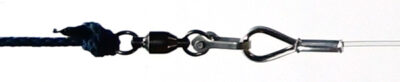
Although the Satellite remained stable and did not spin in all testing, we suggest using a strong swivel and shackle to connect to the tow rope.
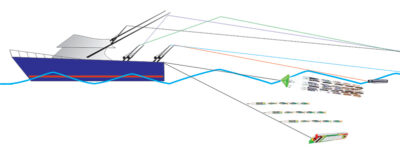
Run the Satellite as a Lure or Spreader Bar:
To run as a normal lure position, the Satellite is in the lower third of the second or third pressure wave. It is easily deployed and retrieved by hand.
It’s also effective to run it so that it creates Black Ripples. This is where the Satellite is positioned in the trough or back of a pressure wave, so it runs just below the surface while creating a bulge on the surface. You may use trolling weights to get it to Black Ripple in the position you want. Black Rippling is also a very effective way to run Bullet Lures. You can certainly run both options on outriggers in any desired positions.
Run Deep as a Dredge:
The Satellite can be run deep by trolling with weights on the tow line, using downriggers with dredge weights, and using planning boards.
The Satellite has a slim profile, so it creates minimal drag, so you don’t need weights as heavy as you would using bars.
Get the Most Out of Using the Satellite
The Satellite Triple Strip Version) was initially tested by Matt Alders on holiday off Fiji’s Coral Coast in late June 2026 for over 70 hours. The teaser attracted over twenty Wahoo up to forty kilos with lures directly behind it. The teaser sustained no damage as the crew ran several hooked lures close behind it. This is a great way to increase your catch rate and minimise damage using all types of teasers.
The ultimate setup is to run the Satellite on the lower third of the second or third pressure wave, with a Witchdoctor Teaser with strips on the tow rope and a lure or two in the lower third of the following pressure wave.